
Refund Policy
We want you to be delighted with your purchase. If for any reason you’re not, please return the item to us in its original condition within 28 days of delivery for a full refund.
Return address:
Paul Fraser Collectibles
94 Whiteladies Road
Bristol BS8 2QX
UK
Please note, we are unfortunately unable to offer returns on any celebrity hair. All items are returned at buyer’s expense.
Description
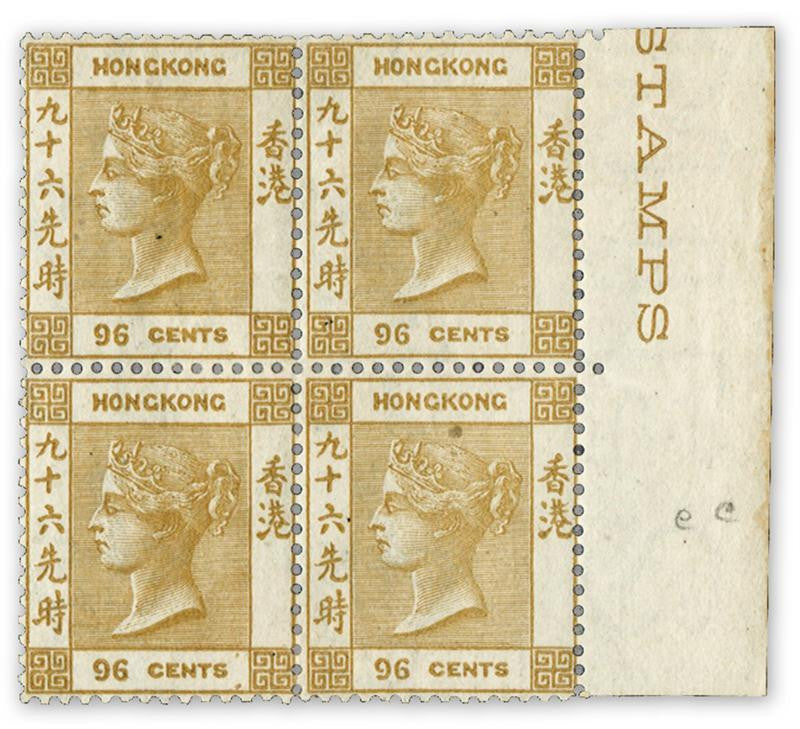
Hong Kong 96c Olive-Bistre Unique Block of Four Postage Stamps
For Sale: £960,000.00
- Unique colour error block of four in outstanding condition
- A legendary philatelic item - the treasure of Hong Kong postal history
- Shows an additional error of watermark
- Previously housed in the most respected Hong Kong collections
Description
The unique 96c olive-bistre colour error right margin block of four with full original gum, superb centring and exceptionally fresh colour.
The block shows the original streaky gum associated with all stamps printed at this time. This gum is usually lost, if treated at all. There are two pencil marks on the margin which have been on the block for a long time, their origin is unknown.
Typical hinge remainders on the reverse and the fourth stamp has a small natural paper inclusion.
The block also shows the variety error of watermark, which is centred unusually low, with the letters "C C" appearing above the crown and at the top of the stamps.
Without question the rarest and most important item of Hong Kong philately.
History
Following the success of the Great Britain Penny Black stamp in 1840, and the subsequent successful adoption of the pre-paid postal system in other countries, the first stamps of Hong Kong were issued in 1862.
These first issues of 1862 included seven values; 2c brown, 8c yellow-buff, 12c pale blue, 18c lilac, 24c green, 48c rose, and 96c brownish grey.
There were two printings of the 96c totalling 138 sheets, with 240 stamps per sheet.
In 1863, British printers De La Rue changed to a new paper and introduced the Crown over CC (Crown Colony) Watermark as an additional security measure.
Further printings of the 96c stamps were not required until March 1864, when another 52 sheets were printed and despatched to Hong Kong.
On delivery, the Hong Kong Post Office failed to notice this new supply of stamps had been printed in an olive-bistre colour, as opposed to the correct 'brownish grey' shade.
This all-important error of colour was only discovered when the stamps were first needed at the Post Office counters, but it was too late to prevent the incorrect coloured stamp from being used.
An order for the supply of stamps in the correct colour took six weeks to reach the printers and a further six weeks to be printed and despatched to Hong Kong. During this period old stocks of the 96c brownish grey were exhausted and a few of the olive-bistre colour error had to be circulated.
The 96c olive-bistre had a very short life. The colour errors were circulated around January/February 1865 until the correct brownish grey stamps became available in late July/August 1865
Rarity
Only 48 unused examples have been recorded, including this block of four.
The block of four is the only unused multiple of the 96c olive-bistre. It is thought that only one other multiple exists - a used pair.
Such is the importance of the stamp that detailed records are now being kept of all the unused examples and the names of famous collectors, past and present, appear on this roll of honour.
The key to the rarity of the 96c issue lies with the postal rate of the time. In 1865, the rates for a letter weighing under ½oz, posted from Hong Kong, were as follows
To U.K. via Southampton 24c
To U.K. via Marseilles 32c
To U.S.A. via Southampton 46c
To U.S.A. via Marseilles 54c
Local and regional letters 8c
Hence there was limited demand for the 96c denomination stamp, which explains why only two examples on cover are known to exist. The stamp is a noted rarity of Hong Kong, widely collected among enthusiasts in the area.
Provenance
The unique block of four has rarely changed hands or been offered for sale. It has graced only the most important collections of Hong Kong.
George Burghard
A noted philatelist from New York, George Burghard assembled specialised collections of Hong Kong and early Switzerland. He sold the 96c olive-bistre block privately circa 1961. He signed the roll of Distinguished Philatelists in 1960.
Ryohei Ishiwaka
The Ryohei Ishiwaka Collection of Postage Stamps and Postal History of Hong Kong and Treaty Ports was sold by Sotheby's in December 1980. The 96c olive-bistre block of four was displayed in pride of place on the front cover of the auction catalogue.
Richard C.K. Chan
Richard C.K. Chan compiled an extensive collection of Hong Kong Philately which encompassed every aspect of Hong Kong philately. His love of the philately of Hong Kong and the Treaty Ports spanned over 30 years.
Comparables
The similarities between the number of unused examples known to exist means that it is inevitable that the 96c olive-bistre is compared to the Small Dollar of China.
Both stamps are considered to be key in any collection, and there is only one block of four existing of each issue.
Chinese stamp market
Stamp collecting was actually banned by Chairman Mao and since his death in 1976 the hobby has thrived.
Beginning in 2000, the Chinese government reportedly made it an official policy to foster stamp collecting in youngsters - mainly as a way to foster interest in national history.
Elementary and high school teachers were encouraged to organise clubs. Today, the country is believed to have almost 50,000 philatelic associations, and universities in Fujian and Jiangxi offer elective courses in stamp collecting.
The sheer size of the Chinese population is key to its large - and growing - representation in the global philatelic community. There are now an estimated 18m stamp collectors in China (one third of the worldwide total).
Stamps are recognised as an easily traded currency; they are tangible assets that are highly portable. The rarest stamps are considered to be important cultural icons and treasures - just like art.
The popular 1980 Year of the Monkey 8f stamp is a fair barometer of the market, having increased in value by 373% since 2006.
Large collections are now being formed as the great and classic stamps are being repatriated by a number of wealthy collectors.
As previous provenance shows - the collection that features the unique Hong Kong 96c olive-bistre block of four, the jewel of Hong Kong philately, will likely be considered the finest.
